Deals rarely fail without warning. In almost every stalled or lost enterprise opportunity, the warning signs were visible weeks earlier—they were just buried under rep optimism.
Dealwize continuously maps your active opportunities against the Deal Risk Matrix, alerting both reps and managers before a slip damages the quarter.
1. What It Is#
The Deal Risk Matrix is an automated diagnostic engine inside Dealwize that scans customer interactions—call transcripts, email threads, response latency, and Mutual Action Plan velocity—to identify unaddressed deal vulnerabilities.
Instead of waiting for a rep to manually flag that an opportunity is in trouble, Dealwize categorizes risks into three operational tiers:
Severity Tier     Operational Meaning                           Typical Example
─────────────     ───────────────────                           ───────────────
High Risk (Red)   Direct threat to close date or budget         CFO sign-off required but unengaged; single-threaded
Medium (Amber)    Velocity drag or committee friction           Unscheduled Infosec review; overdue buyer MAP task
Low (Gray)        Process hygiene & minor alignment items       Vague next step agenda; collateral unconfirmed
2. The Two-Tier Risk Inspection Experience#
Dealwize presents risk intelligence in two complementary layers:
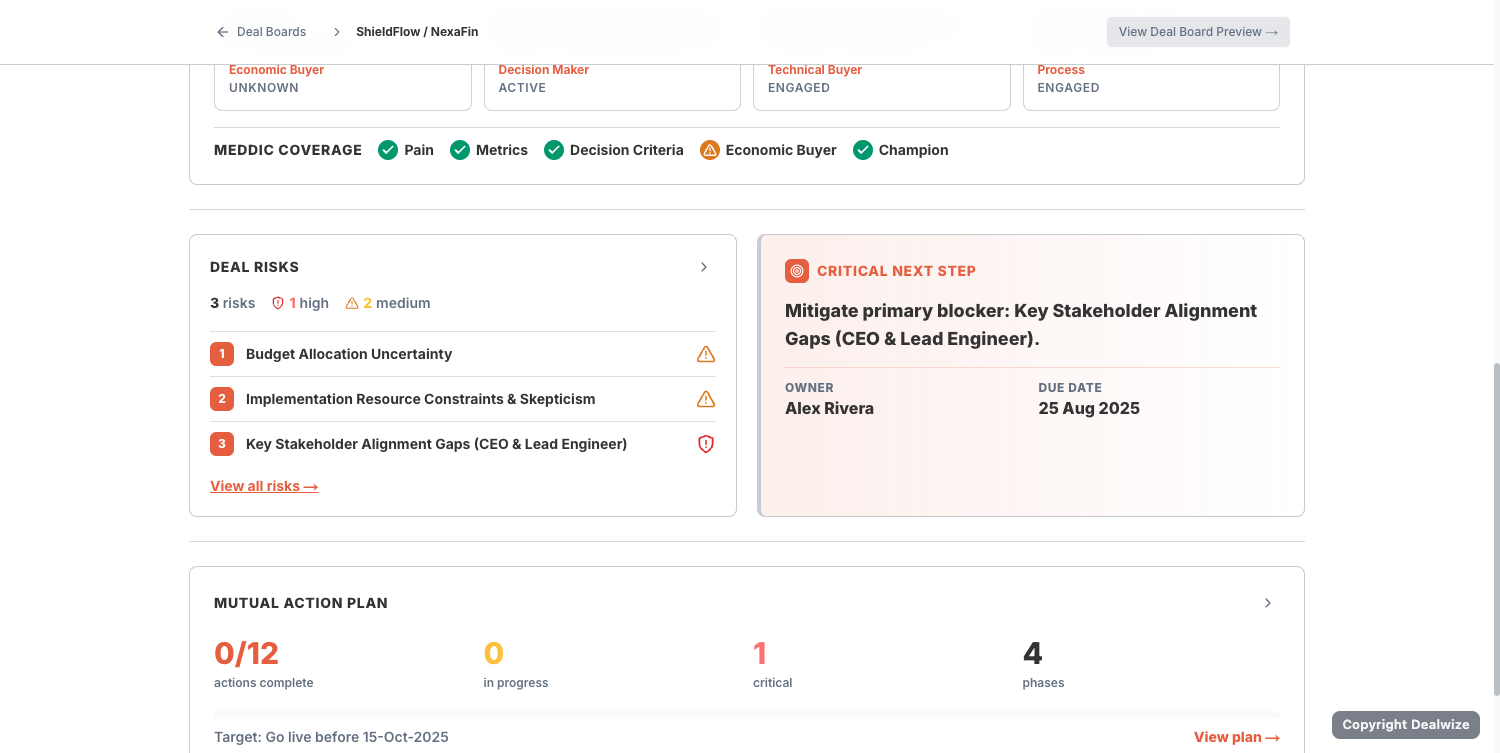
- The Executive Deal Tile (Main Dashboard): Displays the top 3 highest-priority blockers directly on your deal overview (e.g. Budget Allocation Uncertainty, Implementation Resource Constraints, Stakeholder Alignment Gaps), summarized with severity counts (e.g.,
1 high,2 medium). Directly adjacent is the Critical Next Step, prescribing the single highest-leverage intervention with an assigned owner and due date. - The Deep-Dive Evidence Modal (
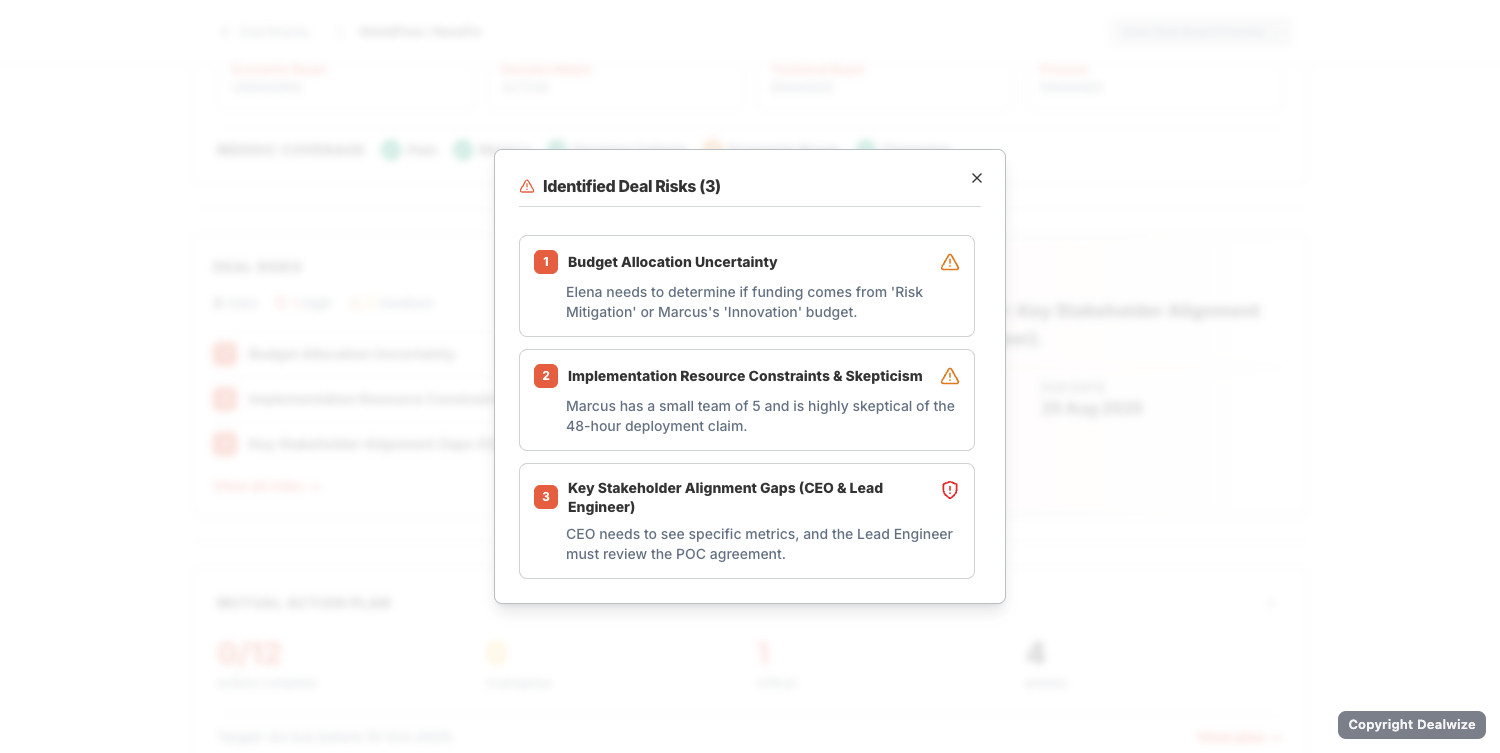
View all risks →): Clicking the link opens a detailed modal displaying the complete inventory of identified blockers, along with the exact conversational quotes and buyer context backing each flag.
3. Why It Matters#
In traditional sales teams, identifying deal risk relies on self-reporting. Reps naturally report good news and downplay hesitations until the end of the quarter.
By the time a manager discovers that legal redlines haven't started or that the champion is on leave, it is too late to fix.
The Deal Risk Matrix surfaces these hurdles weeks in advance, transforming potential deal-killers into calm, collaborative problem-solving sessions with the buyer.
4. What to Look For: The 7 Core Risk Categories#
Dealwize automatically categorizes risks across seven foundational dimensions of complex B2B deals:
| Category | Typical Warning Signal | What It Threatens |
|---|---|---|
| Commercial | CFO sign-off required for contracts over £100k, but economic buyer not engaged. | Commercial viability & pricing approval |
| Stakeholder | Single-threaded account; champion lacks executive sponsor access. | Committee consensus & internal political capital |
| Timing | Target go-live date requires close by month-end, but vendor evaluation still open. | Forecast quarter & close date validity |
| Procurement | Custom legal terms requested with no redline kickoff date scheduled. | Paper process velocity & contracting lead time |
| Technical | Architecture integration dependencies or legacy migration concerns unaddressed. | Solution validation & technical sign-off |
| Competition | Prospect actively benchmarking against incumbent or lower-cost rivals. | Differentiation & margin protection |
| Engagement | Buyer milestones in the Mutual Action Plan untouched for $>7$ business days. | True buying intent & deal momentum |
5. What Dealwize Does: Verifiable Evidence Over Rep Sentiment#
Rather than assigning generic risk flags based on seller opinion, Dealwize roots every risk in concrete conversational evidence:
- Transcript Evidence Citations: Every flagged risk card displays the exact verbatim sentence and timestamp extracted from your customer calls or email threads, eliminating subjective debate between rep and manager.
- Scoring Impact: The Risk Sentinel agent automatically deducts points from your Deal Health score (
-15per High Risk,-5per general risk) until verified proof of resolution is detected. - Critical Next Step Assignment: Dealwize pairs each risk profile with a prescribed immediate action (e.g. "Mitigate primary blocker: Key Stakeholder Alignment Gaps") with an owner and target due date.
6. What the Seller Should Do#
For the Seller: Resolving Deal Friction#
When a risk is flagged on your deal report:
- Review the Quoted Evidence: Read the exact customer quote backing the risk to understand the prospect's hesitation.
- Check the Recommended Next Step: Review the prescribed action item generated by Dealwize.
- Collaborate with Your Champion: Address the obstacle openly—for example, by offering a structured compliance review or executive-to-executive alignment call.
For the Sales Leader: Coaching with Deal Diagnostics#
During 1-on-1 deal reviews:
- Filter your team pipeline by High Risk blockers.
- Avoid asking "Why hasn't this closed?"
- Ask: "What is the specific hurdle blocking the buyer right now, and how can we help our champion remove it this week?"
Related Guides & Deep Dives#
- Understand health scoring: Understanding Deal Health & Scoring Mechanics
- Build collaborative buyer plans: Creating & Sharing Mutual Action Plans on the Deal Board
- Qualify across frameworks: Automated Deal Qualification: MEDDIC, BANT & CHAMP
- Resolve objections collaboratively: Interactive Q&A Module: Contextual Objection Resolution