A deal does not become healthy because a sales rep logs twelve emails, schedules three demos, and feels optimistic about the relationship.
In complex B2B sales, high activity often masks severe underlying uncertainty. Deal Health in Dealwize is an objective, continuous measurement of uncertainty reduction. It evaluates whether the buyer is providing verifiable evidence of an active decision process—or whether the deal is coasting on seller optimism toward an end-of-quarter slip.
1. What It Is#
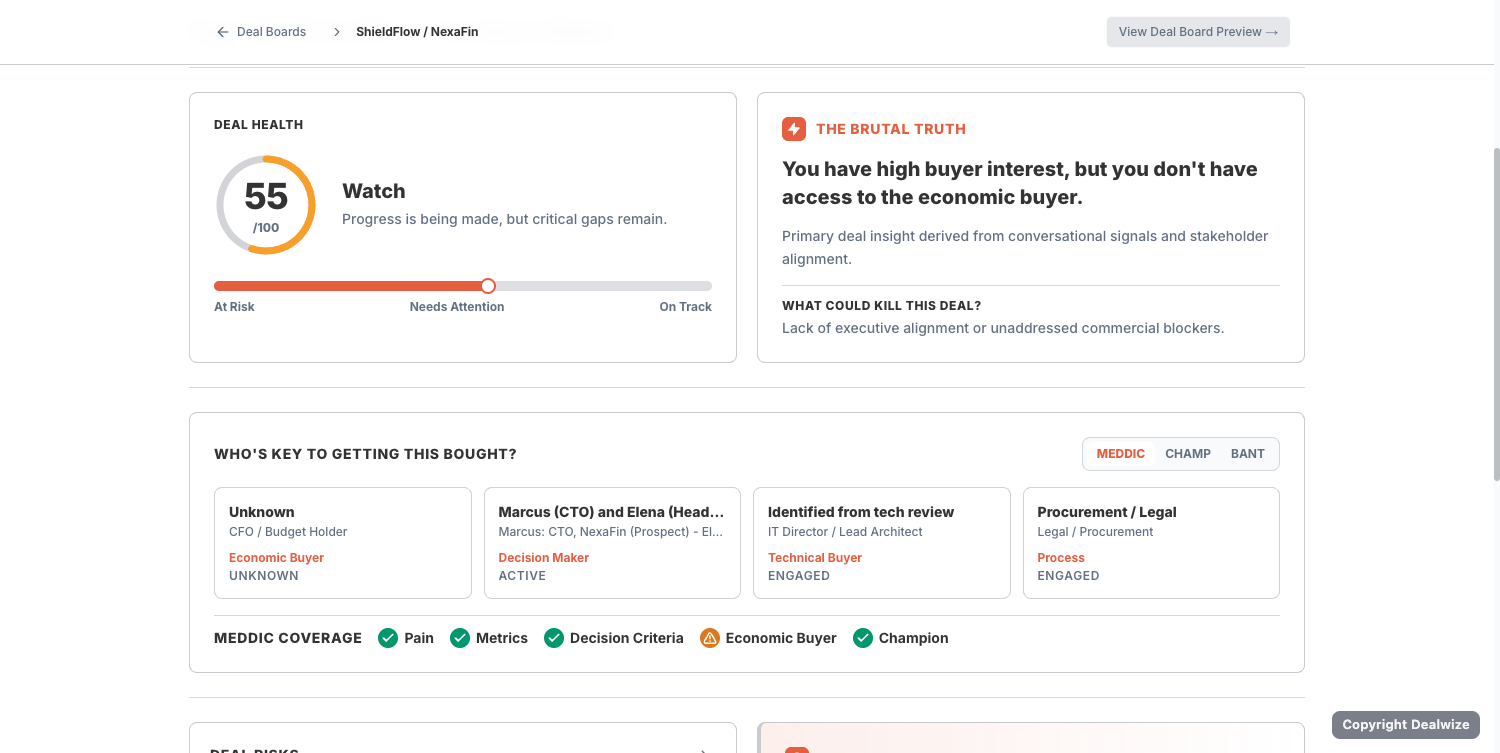
The Dealwize Deal Health Score (0–100) is an algorithmic assessment of opportunity viability derived from customer interactions: call transcripts, email threads, mutual action plan progress, and stakeholder engagement.
Rather than relying on subjective CRM stage probabilities (where an opportunity magically becomes "80% likely to close" simply because a proposal was sent), Deal Health weighs verified buyer commitments against known deal risk factors.
Score Range    Health Status       Operational Meaning
───────────    ─────────────────   ───────────────────
75 – 100       Strong / Healthy    High verified buyer reciprocity, stakeholder alignment, milestones on track.
50 – 74        Watch / Improving   Active progress, but critical gaps remain (e.g. unverified Economic Buyer).
25 – 49        At Risk             Single-threaded contact, unresolved high-severity blockers, timeline drift.
 0 – 24        Critical            Zero recent buyer reciprocity, missed target dates, severe risk of No-Decision.
2. Why It Matters#
Most weekly pipeline reviews are exercises in mutual storytelling:
- The seller recounts their favorite moments from the call.
- The manager questions whether the close date is realistic.
- Both look at logged activity metrics to reassure themselves that progress is being made.
This produces forecast theatre. The opportunity appears healthy right up until the final week of the quarter, when the customer suddenly stops replying or announces that procurement will take eight weeks.
By measuring the presence or absence of verified evidence, Deal Health removes the guesswork. It answers the fundamental question: Are we progressing the customer's buying decision, or are we just keeping ourselves busy?
3. What to Look For#
When reviewing Deal Health across your pipeline, distinguish between three levels of deal reality:
| Signal Level | What It Looks Like | How Deal Health Interprets It |
|---|---|---|
| Opinion | "The champion loves our vision; they're presenting it internally." | Zero weight. Rep sentiment without corroborating buyer data does not increase health. |
| Activity | 5 calls logged, 14 emails sent, proposal viewed twice. | Low weight. Indicates vendor effort, but does not prove buying intent. |
| Buyer Evidence | CFO attended call 2; security requirements returned; mutual timeline confirmed in writing. | High weight. Measurable risk reduction that drives health toward 75+. |
Key Diagnostic Warning Triggers#
- The "Happy Ears" Divergence: A high CRM stage combined with a low Deal Health score (<50). This occurs when a rep advances a deal without securing Economic Buyer access or verified decision criteria.
- Stage Dwell Stagnation: An opportunity remaining in evaluation $>1.5\times$ your winning deal baseline without updated buyer evidence.
- Asymmetric Effort: The seller completes multiple tasks while buyer milestones in the Mutual Action Plan remain untouched for $>7$ business days.
4. What Dealwize Does: The Multi-Agent Diagnostic Engine#
Dealwize continuously analyzes raw conversational data through specialized autonomous agents to construct your deal intelligence:
- The Brutal Truth Engine: Synthesizes transcripts, buyer engagement, and stakeholder gaps into a single unvarnished reality statement (for example: "You have high buyer interest, but you don't have access to the economic buyer"), accompanied by an explicit "What Could Kill This Deal?" analysis.
- Value Architect: Identifies the customer's core North Star business objectives, pain points, and quantifiable metrics, providing an immediate scoring lift (
+5) when verified. - Milestone Miner: Extracts agreed deadlines, milestones, and deliverables to populate the Mutual Action Plan (
+5scoring lift). - Risk Sentinel: Continuously scans for friction, authority gaps, and timeline drift—deducting points for high-severity blockers (
-15) and operational risks (-5). - Qualification Framework Blending: Calculates real-time evidence coverage across MEDDIC, CHAMP, or BANT (Pain, Metrics, Decision Criteria, Economic Buyer, Champion), blending framework completeness directly into the overall Deal Health score.
5. What the Seller Should Do#
For the Seller: Gaining Clarity and Confidence#
When Deal Health flags an opportunity in the Watch or At Risk zone:
- Read The Brutal Truth: Check the unvarnished diagnostic at the top of your report to see the root cause of friction.
- Review Stakeholder Coverage: Toggle between MEDDIC, CHAMP, or BANT to see who is missing (e.g. Economic Buyer marked
UNKNOWN). - Execute the Recommended Next Step: Use the next interaction to secure the missing proof rather than sending another generic check-in email.
For the Sales Leader: Coaching with Evidence#
During 1-on-1 pipeline audits:
- Filter your team pipeline by Watch and At Risk opportunities.
- Replace "How do you feel about this deal?" with "What buyer action from this week's calls justifies keeping this in the current commit?"
- Coach the rep on multithreading techniques to engage the true Economic Buyer before the quarter draws to a close.
Related Guides & Deep Dives#
- Detect hidden blockers: Managing and Resolving Deal Risks: The Deal Risk Matrix
- Build collaborative plans: Creating & Sharing Mutual Action Plans on the Deal Board
- Track sales methodologies: Automated Deal Qualification: MEDDIC, BANT & CHAMP
- Measure buyer engagement: Buyer Engagement Telemetry & Behavioral Analytics